KUANGTU HANDBAGS editorial team
At a glance
Coach began in New York in 1941. Its own history connects the house to leather craft and practical design, while the Tabby revisits an archival 1970s shape. When comparing Coach-named bags, start with the opening, strap arrangement and usable proportions: a flap bag, a compact zip-top shoulder bag and a handled satchel answer different carrying needs.
Where does Coach come from?
Coach's official brand story dates its founding to New York in 1941 and describes a workshop of six artisans making practical leather goods. The business developed under Lillian and Miles Cahn. Bonnie Cashin became its first lead designer in 1962, bringing an emphasis on colour, proportion and a mobile way of dressing.
That history gives useful context for looking at the bags, without deciding which one suits you. A recognisable brand name does not tell you whether a zip is easy to reach, whether a strap clears a winter coat or whether your glasses case fits beside a wallet. Those are the details to compare on the exact version.
Sources: Coach Singapore — Coach Story: founding, artisans and Bonnie Cashin
What does the Tabby borrow from the archive?
Coach describes its Tabby Shoulder Bag 26, style CH857, as a modern interpretation of an archival 1970s design. The official reference has a structured flap shape, Signature hardware and two detachable straps. Its published details specify polished pebble leather, a snap closure and inside zip and multifunction pockets.
The useful design idea is versatility: changing the strap changes how close the same bag sits to the body. These details belong to the named official reference. A quilted, denim or smaller Tabby-named listing may have a different strap, lining and internal layout. Our separate Tabby 26 guide compares construction variants rather than treating the whole family as one specification.
Sources: Coach Singapore — Tabby Shoulder Bag 26, CH857: product details and archival design
Three handbag shapes, three different starting points
For a flap silhouette, examine how far the flap opens and whether the fastening is convenient with one hand. A more structured front can organise the shape, but exterior width alone does not establish the usable opening or the space around a rigid pouch.
For a compact shoulder bag such as a Teri-named catalogue reference, compare the short strap position, the zip opening and any separate long strap. The question is whether you want the bag tucked under an arm or hanging lower. Ask for the strap drop and a photograph of the exact arrangement you intend to use.
For a handled satchel such as the Mini Boston-named reference below, start with the handle clearance and depth. Top handles make a different carrying proposition from a shoulder strap. A long strap appearing in a photograph still needs confirmation as an included accessory for the selected SKU.
Read the material field alongside the photographs
A brand history rooted in leather does not mean that every bag carrying that brand reference is all leather. The denim Tabby reference shown here is supplier-described denim; other catalogue entries use store-provided leather descriptions. Neither is a laboratory composition report.
Inspect the main body, trim, strap and lining separately. Ask which parts a material statement covers, request a close-up of the surface and confirm care instructions for the exact item. A signature pattern is a visual detail, not a material specification or proof of brand identity.
Turn a style preference into a useful shortlist
Start with a carrying task: a phone and a few essentials, a short commute or a shop assortment built around several shapes. Then compare one flap reference, one zip-top shoulder reference and one satchel. Write down the largest object each needs to hold and the preferred strap position.
The catalogue examples below are useful because their information gaps differ. The Teri entry lists three dimensions; the Mini Boston entry lists two, so depth remains a question. Save the exact SKU and option to your enquiry and request missing measurements, current availability and a written quote. KUANGTU is independent of Coach; supplier brand names are references and are not authentication or authorised-dealer claims.
Catalogue references to compare
These photographs and records are separate from the official brand sources. Supplier-listed specifications do not authenticate an item or confirm an exact match to a retail model.
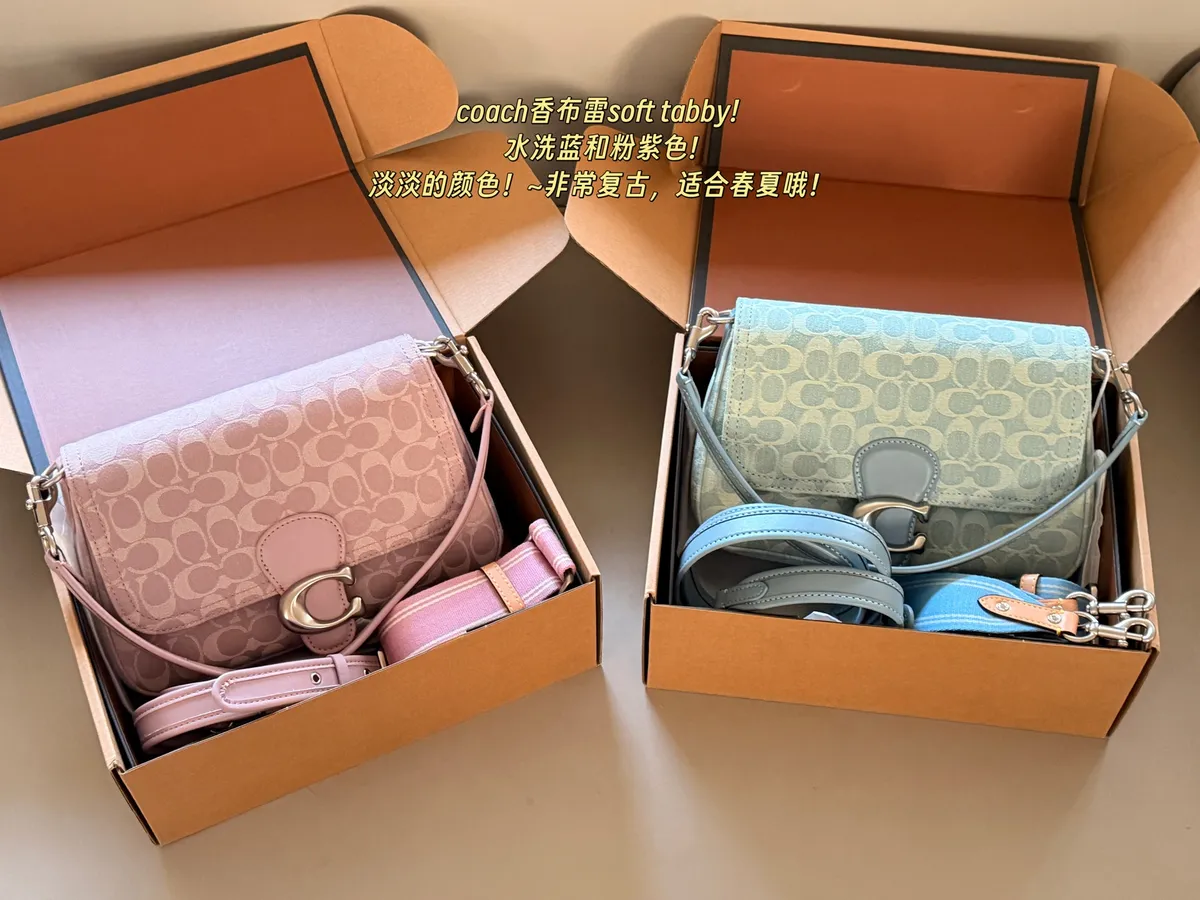
 Coach Tabby Denim Crossbody Bag — 26 × 17 cmSKU KU-030F9488 · Supplier-listed: 26 × 17 cmBrand identity not independently authenticatedView photographs & item details →
 Coach Teri Shoulder Bag in Leather — Beige and TanSKU KU-68519E66 · Supplier-listed: width 24 cm × height 13 cm × depth 7 cmBrand identity not independently authenticatedView photographs & item details →
 Coach Mini Boston Satchel in Leather — Beige SignatureSKU KU-A699CD59 · Supplier-listed: width 18 cm × height 12 cmBrand identity not independently authenticatedView photographs & item details →
Questions & answers
Is Coach an American brand?
Coach's official history states that it was founded in New York in 1941. That describes the brand's origins; it does not establish the manufacturing country of every product or the origin of a supplier-listed item.
Are all Tabby bags made from the same leather?
No single material specification should be applied across the family. The official CH857 reference cited here lists polished pebble leather. Compare the exact model and material field for quilted, denim and other versions.
Does the brand story authenticate the linked catalogue items?
No. The linked KUANGTU items contain supplier-listed information and carry an unverified brand-identity notice. Official history and model specifications do not authenticate those items.
Continue exploring
- Coach Tabby 26: pebbled vs quilted construction
- Shoulder Bag vs Crossbody: Differences & How to Choose
- Coach handbag catalogue and supplier-listed details
Prepare a wholesale enquiry
Use the catalogue SKU, selected option and quantity in your brief, then add your delivery country and the details you need confirmed. Wholesale orders start from 5 pieces; the permitted mix, samples and shipping are confirmed in the quote.
Wholesale ordering: minimum quantity, samples and quote stepsSources & scope
An evergreen brand introduction, not a report of a new launch. Official brand history and the named retail model were read on 22 September 2026. Catalogue examples use separate supplier or store-provided records. No physical product test or brand authentication was performed; no affiliation with Coach is implied.